Blog Article
Patent
Essential Guide to Patent Validity: Everything You Need to Know
Sep 14, 2026
By M.S Ansari
5 min read
A complete guide to patent validity covering invalidity search, patent validity search reports, legal grounds, and how to protect your IP with professional services
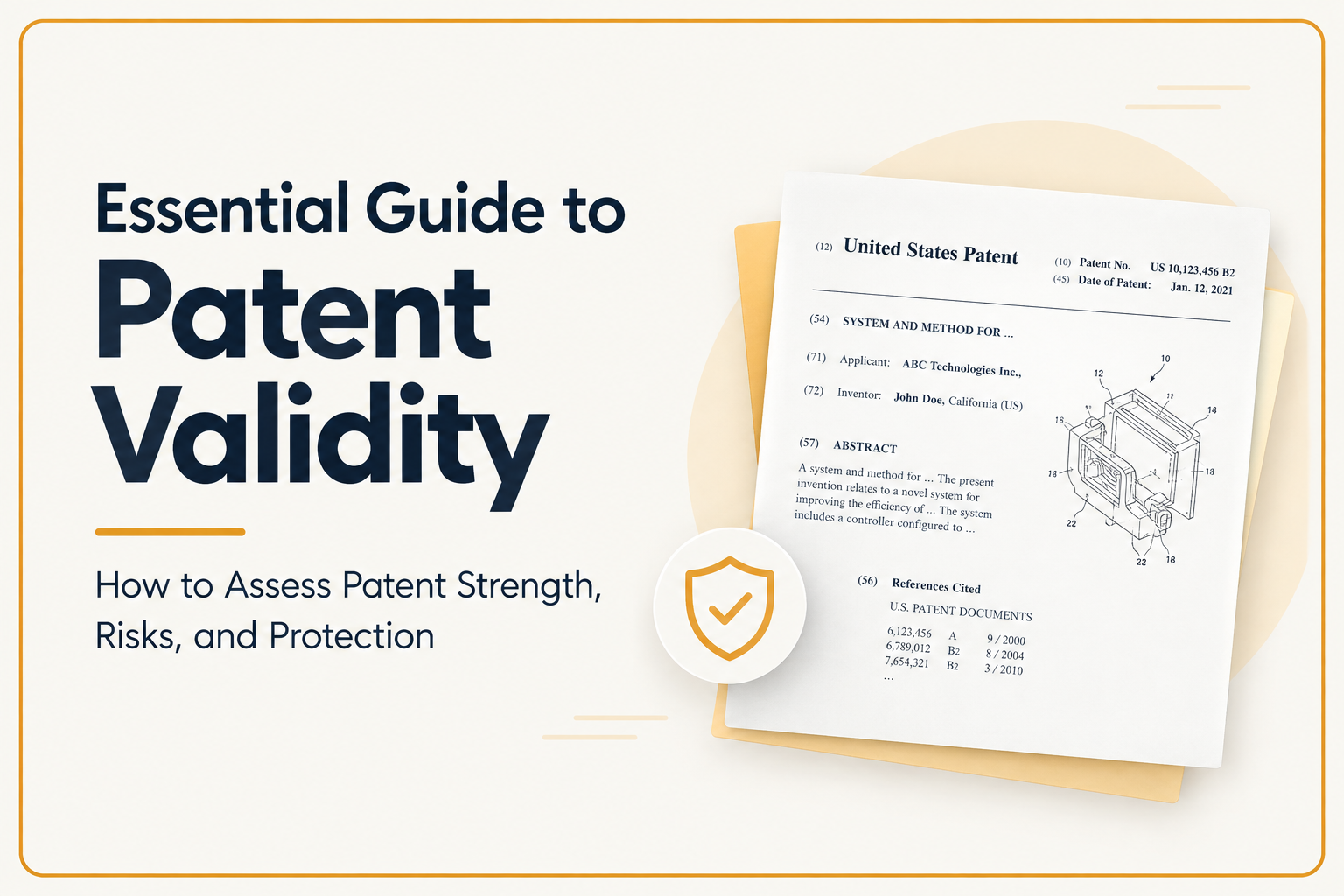
Understanding patent validity is critical for inventors, businesses, and legal teams alike. Whether you are defending your intellectual property or challenging a competitor's patent, knowing how patent validity works can make or break your IP strategy.
Patent validity refers to the legal enforceability of a granted patent — that is, whether a patent truly meets the conditions required by law for it to remain in force and be used to prevent others from using, making, or selling the patented invention.
If you already hold a granted patent, knowing how strong that patent truly is can be the difference between protecting your invention and losing it. This is where patent validity search services become essential. A professionally conducted patent validity search report gives you a clear picture of how enforceable your patent claims are — and that knowledge matters in three critical situations:
For businesses, understanding the validity of patent protection is essential before making major commercial decisions — from licensing a technology and acquiring a company to defending against an infringement lawsuit.
A patent validity search is not just a formality — it is a strategic tool that protects your business and strengthens your IP position. Here is why it matters:
One of the most frequently asked questions in intellectual property is: do patents expire? The short answer is yes — every patent has a fixed lifespan.
In most countries, including the United States, India, and across the European Union, the term of patent validity is counted from the date of filing of the patent application — not from the date the patent is granted. This is a crucial distinction that catches many inventors and businesses off guard.
Example: Suppose you filed your patent application on 15 August 2024 and your patent was granted on 19 November 2029. Even though you received the grant in 2029, your patent expiry date will be 15 August 2044 — calculated from your original filing date, not the grant date. Those 5 years spent in examination are not added back to your protection term.
Key implications of this rule:
Example: If you first filed a patent application in your home country on 15 August 2024 and then filed a PCT international application on 11 May 2025 (within the 12-month Paris Convention window), your priority date remains 15 August 2024 — but your international filing date is 11 May 2025. The 20-year PCT term runs from the international filing date, meaning your international patent protection would expire on 11 May 2045.
If you want to challenge or invalidate someone else's granted patent — whether to defend against an infringement claim, clear a competitor's patent blocking your market, or support an opposition proceeding — you need concrete evidence. That evidence takes the form of the closest prior art: earlier patents, research papers, or public disclosures that existed before the target patent's priority date and prove the invention was not truly novel or inventive. The process of finding that evidence is called a patent invalidity search.
Here is how a professional patent invalidation process typically unfolds:
Why hire a professional? A DIY invalidity search risks missing critical prior art hidden in foreign patents or obscure literature. A professional firm delivers a thorough patent invalidity search report — saving you time, cutting legal costs, and giving your challenge the strongest possible foundation.
A patent validity search report (or patent invalidity search report) is a formal, structured document that presents the results of a prior art search alongside a technical and legal analysis of how each reference relates to the patent's claims. A professionally prepared report typically contains the following components:
The quality of this report directly determines the strength of any invalidity argument in court, in opposition proceedings, or in licensing negotiations. This is why it is critical to engage experienced patent validity search services to produce a report that is thorough, well-mapped, and legally sound.
When selecting patent validity search services, look for providers that offer:
Patent validity is an ongoing legal and commercial reality that every business must actively manage. Whether you are defending against an infringement claim, licensing your IP, or conducting acquisition due diligence, the enforceability of a patent determines the outcome. A thorough patent invalidity search and a professionally prepared patent validity search report are not optional extras — they are the foundation of a sound IP strategy.
At Opine IP, we deliver rigorous patent validity and invalidity search services backed by deep technical expertise and global database coverage. From first-pass searches to detailed claim-mapped reports, we give you the intelligence to make confident IP decisions.
1. Which services offer patent validity analysis for startups?
Several IP services firms offer patent validity analysis tailored to the needs and budgets of startups. Opine IP offers startup-friendly patent validity analysis with detailed reporting and expert guidance.
2. Where can I find patent validity reports for technology patents?
Patent validity reports for technology patents are available through specialised IP research firms and patent analytics platforms. These reports cover software, hardware, telecommunications, semiconductor, biotech, and other technology domains.
3. What kind of prior art search services are available to assess patent strength?
A range of prior art search services are available to assess the strength of a patent, including:
Each type of search serves a different strategic purpose, and many IP situations require more than one type of search for a complete picture of patent strength. You can learn more.
Our senior researchers are available for custom consultations.